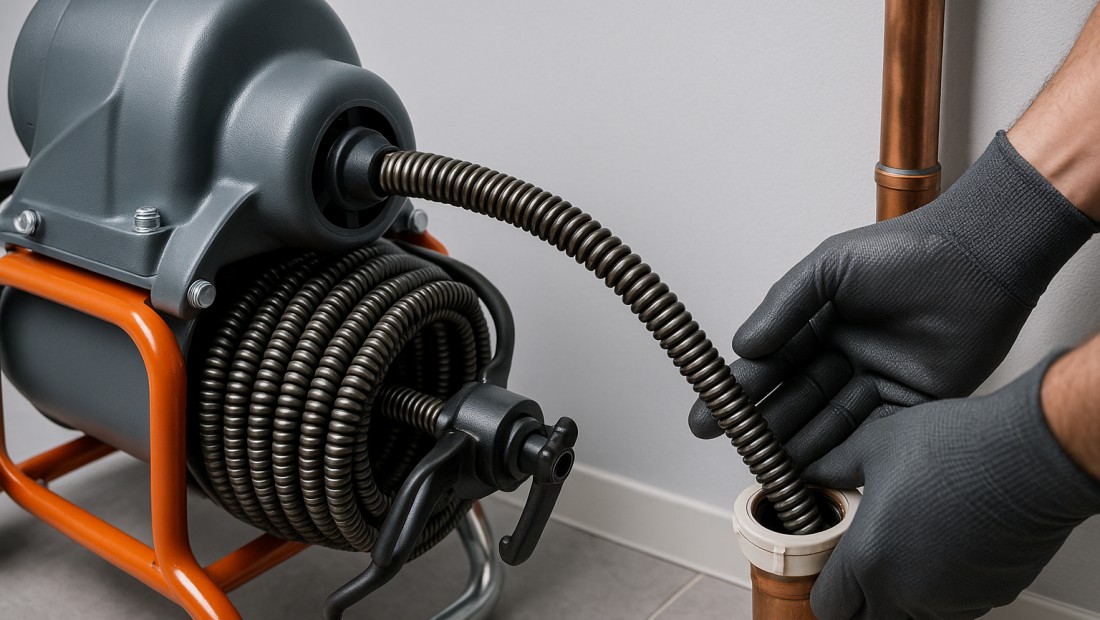
Drain snaking, cabling, and power rodding are different names for the same core technique: feeding a flexible steel cable into a drain to reach a clog and break it apart or pull it out. It's the most common drain-cleaning method for good reason — it's fast, effective on most clogs, and gentler on pipe than chemicals. But there's a real difference between a homeowner's hand auger and the professional machines we run.
A drugstore snake is short, thin, and underpowered. It reaches the trap and maybe a few feet beyond, and on a serious clog it tends to poke a pinhole through the center and bounce back. Our powered machines carry cables of different lengths and stiffnesses, with interchangeable heads — cutters, augers, retrieving hooks — matched to the pipe size and the type of clog, and they reach the full length of a residential line.
The right cable for the job
- Small drum cables for sink, tub, and lavatory branch lines — thin enough to navigate tight traps without damaging fixtures.
- Mid-size cables for toilet branches and laundry lines.
- Heavy sectional and drum machines for 3- and 4-inch main lines, with root-cutting heads that clear the full pipe diameter.
What snaking clears well
Cabling is the right first move for the great majority of clogs: hair and soap in bathroom lines, food and grease blockages in kitchen branches, paper and waste in toilet and main lines, and root intrusion in sewer laterals. A root-cutting head on a main-line machine shears roots back to the pipe wall and restores full flow. For a one-time clog, snaking solves the problem quickly and affordably.
Where snaking has limits
Because a cable opens a path rather than cleaning the whole wall, it has two limits worth knowing. First, on a grease- or scale-lined pipe it leaves the buildup behind, so the line re-clogs — that's where hydro jetting earns its keep. Second, it can't fix a broken pipe; if the line is cracked, collapsed, or bellied, cabling clears the immediate clog but the defect remains. When clogs keep returning after snaking, the honest next step is a camera inspection to find out why.
- Identify the line and clog. We determine which fixture or main is affected and choose the right machine and head.
- Access the line. Through the fixture, a cleanout, or a pulled toilet, depending on the situation.
- Clear the clog. We run the cable to break up or retrieve the blockage and work the full affected length.
- Test the flow. We run water to confirm the line carries freely and check for any secondary clog.
Snaking vs. jetting — the short version
Snake it when you have a discrete clog and want flow restored now, affordably. Jet it when the pipe is coated and the clog keeps coming back. Camera it when you don't know which you're dealing with or the problem recurs. We carry all three capabilities and recommend based on what your line actually needs — not on what costs the most.
If you've got a stubborn clog that a store-bought snake won't budge, a professional machine with the right head usually clears it in minutes. Give us a call and we'll get your line moving again.