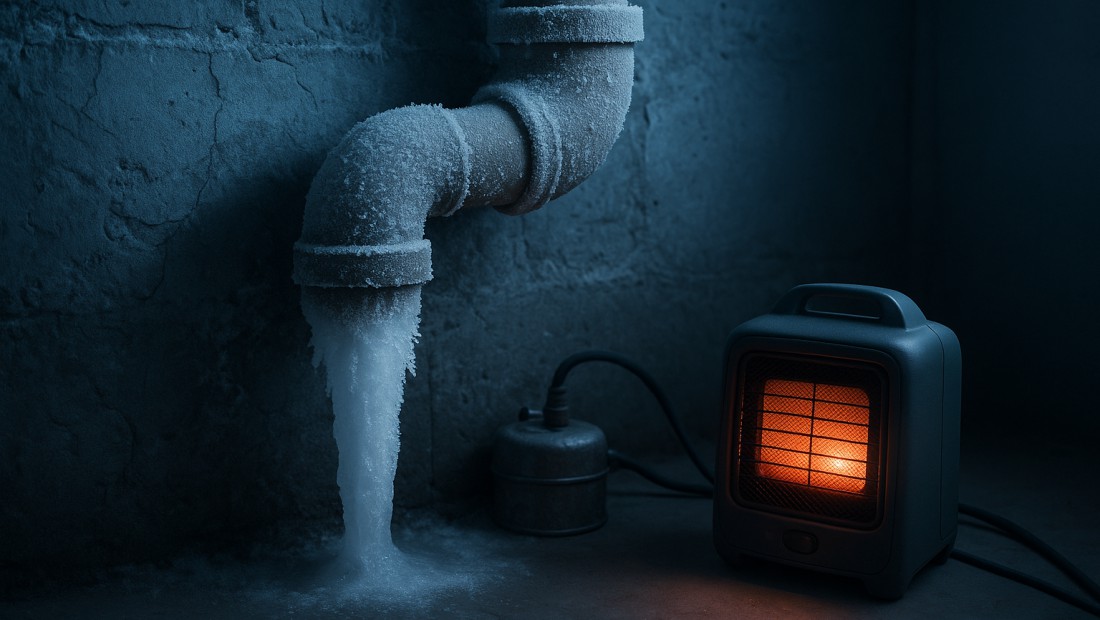
Albany sits in one of the colder parts of the Northeast, with stretches of January and February well below zero and a frost line that drives several feet into the ground. Those conditions reach plumbing that would be safe further south: drain lines in unheated crawl spaces and additions, traps along exterior walls, and — the one most homeowners never think about — the vent stack that pokes through the roof.
A frozen supply line is the famous burst-pipe emergency. But frozen drains and vents cause their own quieter trouble: fixtures that won't drain, gurgling traps, and sewer odor backing into the house when a frost-closed vent stops the system from breathing.
The frozen vent stack
Your drain system needs air. Every time water leaves a fixture, air has to enter behind it through the vent stack — the pipe that runs up through the roof. In extreme cold, the warm, moist air rising through that stack can freeze at the top where it meets the frigid outside air, building a plug of ice that slowly closes the opening. The result is strange: drains slow down, traps gurgle and lose their water seal, and sewer gas seeps into the house. People assume they have a clog and snake the drains for nothing, because the problem is forty feet up on the roof.
Frozen drain lines
Drain lines freeze where they run cold: through an unheated garage or porch, along a poorly insulated exterior wall, or in an addition built over a crawl space. A standing slug of water in a low spot — a trap or a pipe belly — freezes solid and blocks everything behind it. Kitchen lines are especially vulnerable because grease and food residue hold water in the pipe.
How we thaw safely
- Locate the freeze. We trace the line to find where it crosses a cold zone — the thaw has to happen at the right spot.
- Apply controlled heat. We use safe, controlled thawing methods on accessible pipe. We never use an open flame, which cracks pipe and starts fires.
- Clear any residual blockage. Once the ice is gone, we make sure no debris remains where water pooled.
- Address the vent. For a frozen stack we clear the roof opening and discuss insulation or extending/insulating the vent to prevent a repeat.
- Find the weak point. We identify why that section froze and recommend insulation, heat tape, or rerouting so next winter is uneventful.
Why Albany pipes freeze — and crack
It's not only the cold; it's the freeze-thaw cycle. Water expands about nine percent when it freezes, and our winters cycle above and below freezing repeatedly. Each cycle works on pipe joints and on the soil around buried laterals, slowly opening seams. That's why a hard winter often produces a wave of spring backups in Albany — the ground shifts, joints offset, and roots find the new gaps. A line that froze and cracked over winter may not reveal itself until the thaw.
Prevention that actually works
- Insulate drain and supply lines that run through garages, crawl spaces, and exterior walls.
- Keep the vent stack clear and consider an insulated or extended vent if yours has frozen before.
- On the coldest nights, let a faucet on an exterior wall drip and open cabinet doors so warm air reaches the pipes.
- Keep grease out of kitchen drains so they don't hold a slug of water that can freeze.
- Have any line that froze once inspected — freezing often leaves a hairline crack that leaks at the thaw.
If you're staring at a frozen line right now, call us — thawing the wrong way causes far more damage than the freeze itself. And if a drain that froze this winter is now backing up, a camera inspection will show whether the freeze left a crack that needs repair.