Sewer Line Services in Albany, NY
The lateral that carries waste from your house to the city main is the most expensive pipe to ignore. In a region of century-old clay and mid-century Orangeburg, knowing its condition is worth real money.
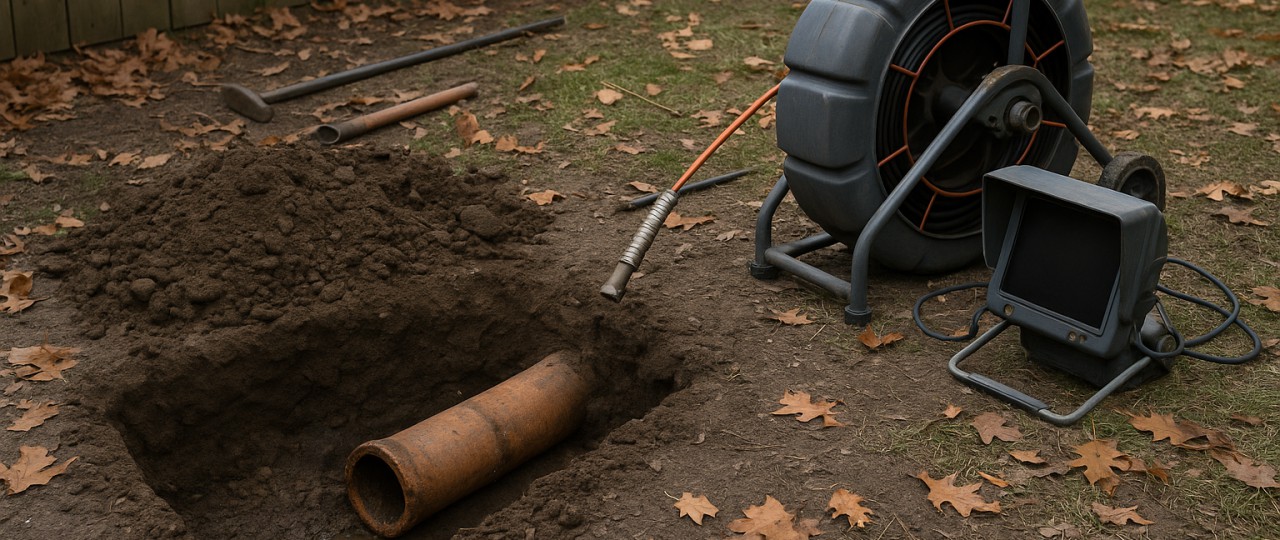
Your sewer lateral — the buried line running from the house to the municipal main — is out of sight and easy to forget until it fails. When it does, the bill is often five figures, and in the Capital Region the odds are higher than most places: the historic core sits on clay and cast iron laid generations ago, and the post-war suburbs are full of Orangeburg, a tar-impregnated fiber pipe that deforms and collapses with age. The work below is about understanding and fixing that line before it becomes a yard full of trench.
The single most valuable thing a homeowner can do with an old lateral is look inside it. A camera inspection turns guesswork into a clear picture — roots, bellies, cracks, scale, or a crushed section — so money goes toward the right fix instead of repeated cleanings. From there, the options range from a routine cleaning to trenchless lining that rebuilds the pipe with little digging, to full replacement when the line is beyond saving.
Why laterals fail here
- Tree roots from mature maples and oaks invading loose clay joints — the leading cause of lateral trouble.
- Failing Orangeburg in 1940s–70s suburbs, which blisters, sags, and collapses on a predictable schedule.
- Frost-shifted bedding that bellies a line into a low spot where waste settles.
- Scaled, corroded cast iron that narrows and roughens until it grabs everything.
- Old, brittle clay that cracks at joints and lets in roots and groundwater.
From a look inside to a permanent fix
Everything that happens to a buried lateral — diagnosing it, cleaning it, and repairing or replacing it when it’s failed.
Sewer Camera Inspection
See inside the line before you spend a dollar on repairs — the diagnostic that anchors every smart sewer decision.
Learn more →Sewer Line Cleaning
Clearing and maintaining the main lateral so the whole house drains — cabling and jetting for the big line.
Learn more →Tree Root Removal
The leading cause of lateral failure in our tree-lined neighborhoods — cut, cleared, and kept out for good.
Learn more →Trenchless Sewer Repair
Reline or replace a failing line through small access pits — ideal for tight lots and frozen ground.
Learn more →Orangeburg Pipe Replacement
The mid-century pipe under so many local suburbs fails predictably. Identifying and replacing it.
Learn more →Sewer Line Replacement
When a lateral is beyond repair: open-trench replacement, and how deep frost-line burial affects the job.
Learn more →Frequently asked questions
Who’s responsible for the sewer lateral — me or the city?
In most Capital Region municipalities, the property owner is responsible for the lateral from the house to the connection at the municipal main, often including the portion under the street or sidewalk. That means a failed lateral is usually the homeowner’s bill. A licensed local pro can tell you where responsibility shifts for your specific address.
How do I know if I have Orangeburg pipe?
If your home was built or re-plumbed roughly between the 1940s and early 1970s — common across Colonie, Guilderland, and parts of Delmar — there’s a real chance the lateral is Orangeburg. A camera inspection confirms it instantly: the pipe’s interior is dark, layered, and often deformed into an oval. Catching it before total collapse saves a far messier emergency.
Do I need a permit for sewer work?
Sewer and excavation work generally requires a municipal permit, and the rules differ between Albany, the towns, and the cities across the river. Licensed local pros handle the appropriate permitting and locate underground utilities before any digging. Don’t let an unlicensed handyman dig up a sewer line.
Is trenchless always better than digging?
Not always — it depends on the pipe’s condition and layout. Lining needs a host pipe sound enough to reline; a fully collapsed line may need bursting or open-trench replacement. But in our climate, trenchless often wins because it moves far less frozen ground and spares yards, driveways, and mature trees. A camera inspection tells you which path fits.
A backed-up drain won’t wait — especially in an Albany winter.
A slow drain on a freezing night can become a backup by morning. Get matched with a licensed Capital Region pro for a free assessment, any hour.