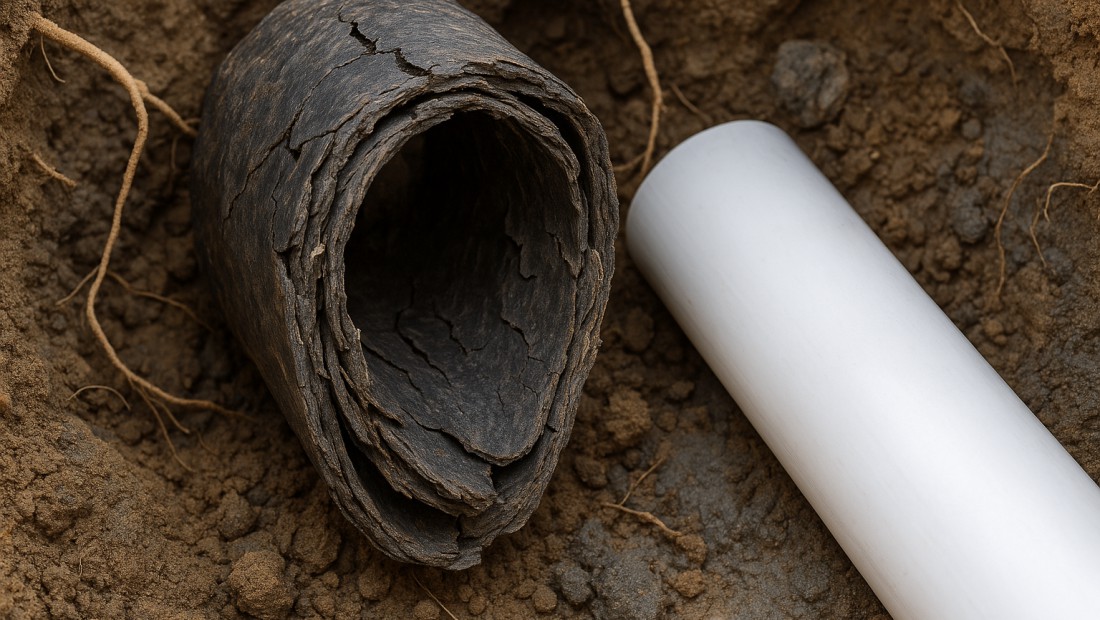
Orangeburg pipe is a particular headache for the Capital Region, and many homeowners have never heard of it until it fails. Manufactured from wood pulp and pitch — essentially rolled, tar-impregnated paper — it was widely installed for sewer laterals from roughly the mid-1940s through the early 1970s, exactly the era when Albany's suburbs boomed. Subdivisions in Colonie, Guilderland, Delmar, Bethlehem, and the postwar fringes of Albany itself were often plumbed with it because it was cheap and easy to cut on site.
The problem is that Orangeburg has a limited lifespan — often cited around fifty years, sometimes far less in our freeze-thaw soils. By 2026, virtually every Orangeburg line still in the ground is at or well past the end of its design life. As it ages, it softens, absorbs moisture, and deforms: the round pipe goes oval, then blisters inward, then collapses. It's a classic source of mysterious, recurring sewer trouble in homes of this vintage.
Signs you may have failing Orangeburg
- Home built between about 1945 and 1972 in an Albany-area suburb — the single biggest clue.
- Recurring backups that cleaning fixes only briefly.
- Roots in the line — soft, deforming Orangeburg is easily penetrated.
- A camera showing an oval or blistered cross-section rather than a round pipe.
- Frequent slow drains as the deformed pipe narrows.
Why it can't just be cleaned
You can cable and jet an Orangeburg line, and it may flow again for a while. But the pipe is structurally failing along its length, not blocked at one point. Cleaning a pipe that's deforming is like patching a cardboard box that's getting wet — you're working against the material itself. Worse, aggressive cleaning or high-pressure jetting can accelerate the collapse. Once a line is confirmed Orangeburg and showing deformation, replacement is the realistic path.
How we replace it
- Confirm with a camera. We verify the pipe is Orangeburg and document the extent of the deformation and any collapse.
- Choose the method. Because Orangeburg is too weak to host a liner, replacement — often trenchless pipe bursting — is the usual route, pulling new pipe through the old path.
- Handle permits and locates. We manage the municipal permits and utility mark-outs the work requires.
- Replace and verify. We install new PVC or HDPE at proper grade and depth, then camera the finished line.
If you're buying a mid-century home
This is one of the strongest arguments for a pre-purchase sewer inspection. A charming 1960 ranch in Guilderland or a tidy split-level in Colonie may have an Orangeburg lateral on the verge of collapse — a substantial expense the seller's disclosure won't mention because they may not know themselves. Spending a little to camera the line before closing can save you thousands and give you real negotiating leverage.
If your home is from the right era and your sewer keeps acting up, Orangeburg is a prime suspect. We'll camera the line, tell you definitively what you've got, and if it's failing Orangeburg, lay out a replacement plan — trenchless wherever your property allows — with honest pricing.