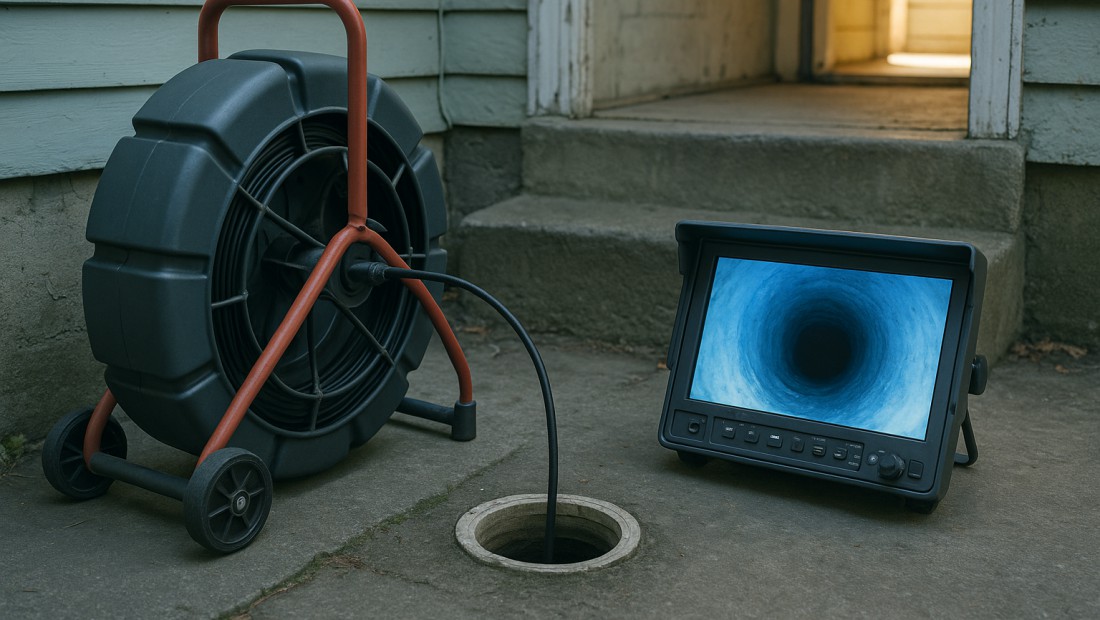
For most of plumbing history, diagnosing a sewer problem meant educated guessing — or digging. A camera inspection ends the guessing. We feed a waterproof, self-lit camera on a flexible rod through your sewer line and watch a live video feed of the pipe's interior, foot by foot, from the house to the connection at the street. Roots, cracks, offset joints, grease, bellies, collapsed Orangeburg — whatever is there, we see it, and so do you.
In the Capital Region, where most homes sit on aging clay, cast-iron, or Orangeburg laterals, a camera inspection is the single most useful diagnostic we have. It turns a vague "your sewer's bad" into a precise picture: what's wrong, where, and how serious — which is exactly what you need to make a smart decision about repairs.
When you should camera the line
- Recurring backups — if the main clogs again and again, the camera shows whether it's roots, a belly, or a failing pipe.
- Before buying a home — an inspection on an older Albany house can reveal a five-figure sewer problem before you close. We strongly recommend it.
- After a backup — to learn whether it was a one-time clog or a sign of something structural.
- Before jetting or repair — to confirm the pipe can take the work and to aim it precisely.
- Slow drains with no obvious cause — to find a hidden obstruction.
What we look for in Albany lines
Our region's pipe ages in characteristic ways, and the camera reveals each clearly:
- Root intrusion — fine roots entering at joints, sometimes filling the pipe with a dense mat. Common under Albany's mature street trees.
- Orangeburg failure — the tar-paper pipe used in mid-century suburbs goes oval, blisters, and collapses. The camera shows the deforming cross-section.
- Cracked and offset clay — freeze-thaw and soil movement shift old clay joints out of alignment.
- Bellies — low spots where the pipe has sagged, collecting standing water and debris.
- Scale and grease in cast iron, narrowing the channel.
Locating the problem precisely
The camera head carries a transmitter. From the surface we use a locator to mark the exact spot and depth of a defect — say, eighteen feet from the foundation, six feet down, under the front walk. That precision is what makes a targeted spot repair possible instead of digging the whole yard, and it's invaluable for planning trenchless work.
- Access the line. Usually through the main cleanout; sometimes a pulled toilet.
- Run the camera. We feed the camera the length of the lateral, narrating what we see on the monitor with you.
- Locate defects. We mark the surface location and depth of anything significant.
- Give you the footage and a plan. You get a clear explanation — and, where useful, the recording — plus honest options ranked by cost.
An honest second opinion
A camera inspection protects you from unnecessary work as much as it identifies necessary work. If another contractor has told you the line needs full replacement, the footage shows whether that's true or whether a targeted spot repair or a good cleaning would do. We'd rather show you the pipe and let the evidence speak than ask you to take an expensive recommendation on faith.
If your sewer keeps backing up, you're buying an older Albany home, or you just want to know the condition of a line before it fails, a camera inspection is where to start. It's quick, it's non-invasive, and it replaces anxiety and guesswork with a clear picture.