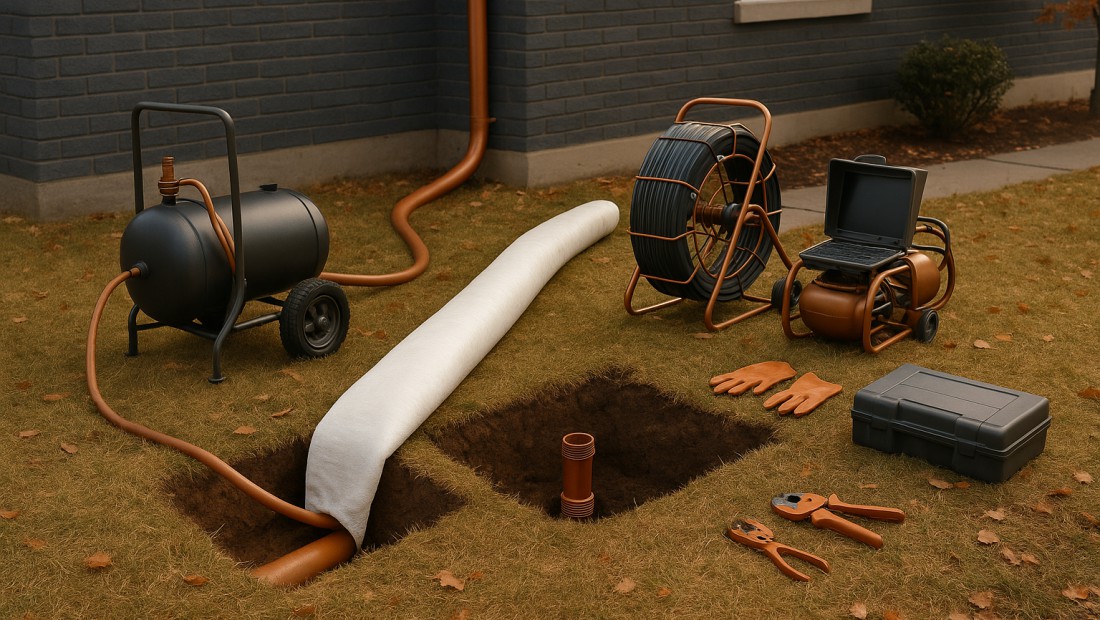
The traditional way to fix a broken sewer lateral is to dig it up — a long, deep trench from the house to the problem, through whatever lawn, garden, walkway, or driveway happens to be in the way. On Albany's older, densely built lots, with mature trees and stone walks and the neighbor's property close by, that's disruptive and expensive, and the restoration afterward can cost as much as the pipe work itself.
Trenchless sewer repair offers a better path for many situations. Using access points at either end of the damaged section, we rehabilitate or replace the pipe with little or no excavation. The lawn stays largely intact, the work goes faster, and in the right circumstances the result is as durable as a dug-and-replaced line — or more so.
The two main trenchless methods
Cured-in-place pipe (CIPP) lining. We insert a resin-saturated liner into the existing pipe and cure it in place, forming a new, jointless pipe inside the old one. It seals cracks, stops root intrusion at joints, and bridges minor defects — ideal when the host pipe is damaged but still structurally present. The jointless interior gives roots nowhere to re-enter.
Pipe bursting. We pull a new pipe through the path of the old one while a bursting head fractures the old pipe outward into the surrounding soil. This fully replaces the line — the right choice when the existing pipe is collapsed, badly deformed, or made of failing Orangeburg that can't host a liner.
When trenchless is the right call
- Cracked or root-infiltrated clay or cast-iron laterals.
- Collapsed or deformed Orangeburg pipe (typically via bursting).
- Lines running under driveways, mature trees, stone walks, or close to the foundation.
- Properties where digging would be especially costly to restore.
When digging still wins
Trenchless isn't always the answer, and we won't pretend it is. A pipe with severe sags or bellies needs the grade corrected, which lining can't do. Some collapses are too complete to pull a new line through. Badly misaligned connections sometimes require an open repair. And occasionally a short, shallow run is simply cheaper to dig. We assess honestly and recommend the method that actually fits your line — not the one that sounds most modern.
- Camera and locate. We inspect the line to define the damage and confirm trenchless is appropriate.
- Prepare the pipe. We clean and clear the line — cutting roots and jetting — so the liner or new pipe seats correctly.
- Line or burst. We install the cured-in-place liner or pull the replacement pipe through.
- Verify. A final camera pass confirms a smooth, sealed, full-diameter line.
The Albany advantage
Our region is exactly where trenchless earns its keep: old laterals that fail, mature trees you don't want to lose, narrow city lots, stone and brick hardscape, and deep burial below the frost line. Avoiding a deep, wide trench across that landscape is a genuine benefit — less disruption, less restoration cost, and a faster return to normal. We'll show you the camera footage, explain which trenchless method fits (or why digging is smarter in your case), and give you honest pricing for each.
If you're facing a sewer repair and dreading the excavator, ask us about trenchless options before you commit to tearing up the yard.