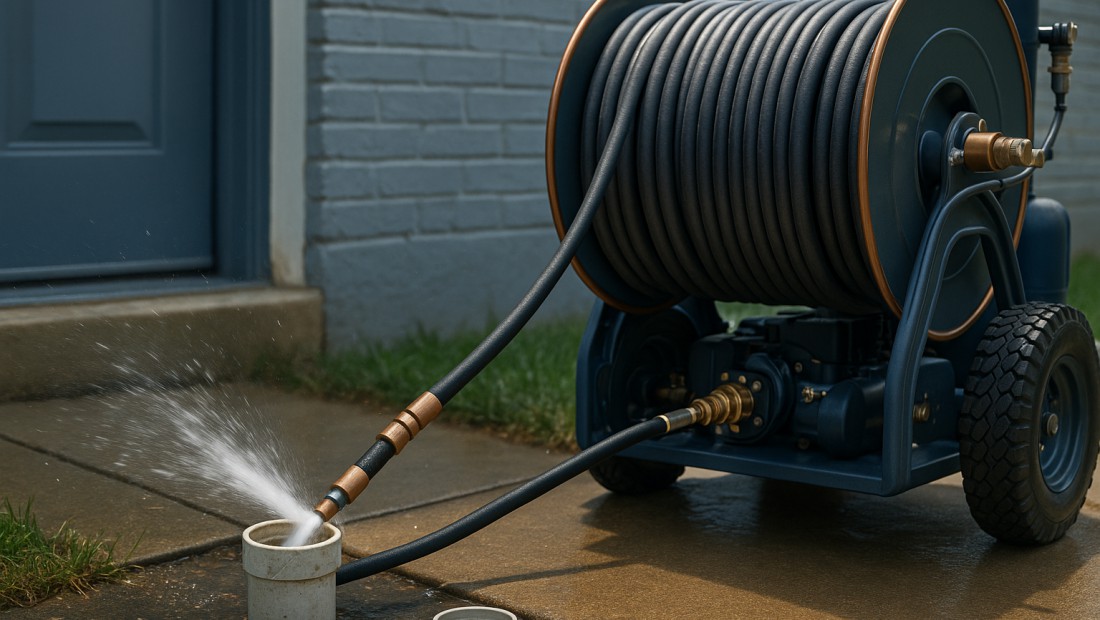
Mechanical cabling — running a spinning blade down the line — is the right tool for many clogs. But it has a limitation: it bores a hole through a blockage rather than removing the buildup that caused it. The grease ring, the scale, the root remnants, the sludge in a pipe belly — a cable leaves most of it on the wall, so the line clogs again. Hydro jetting solves that. It uses water at very high pressure, delivered through a specialized nozzle, to scour the entire inner surface of the pipe back to its original diameter.
For Albany's older lines — cast iron coated with decades of scale, clay laterals catching roots, kitchen branches lined with hardened grease — jetting often makes the difference between a clog that returns every season and a line that stays clear for years.
How hydro jetting works
A high-pressure pump drives water through a hose to a nozzle with jets aimed forward and backward. The forward jets break up the blockage; the backward jets propel the nozzle through the line and blast the walls clean as it travels. The water pressure — far higher than any household source — cuts through grease, flushes out sand and sediment, and shears roots off at the pipe wall. Everything is washed downstream to the sewer, leaving the pipe genuinely clean rather than merely open.
What jetting handles that cabling can't
- Hardened grease lining kitchen and restaurant lines — cabling bores through; jetting strips it off the wall.
- Scale and mineral buildup in old cast-iron pipe common in Albany's historic homes.
- Sand and sediment that settles in low spots and pipe bellies.
- Root intrusion — jetting clears the fine roots and debris a cable snags on, though severe root masses may still need cutting first.
When jetting is and isn't the right call
Jetting is ideal for recurring clogs, grease-heavy lines, and routine maintenance of a healthy sewer. It is not appropriate for a pipe that's already failing — cracked, collapsed, or badly deteriorated Orangeburg — where high pressure could worsen the damage. That's why we camera the line first when there's any doubt. A camera inspection tells us whether the pipe is sound enough to jet, and it lets us aim the work where the buildup actually is.
- Inspect. We camera the line to confirm it's structurally sound and to locate the buildup.
- Clear if blocked. If the line is fully stopped, we cable to restore flow first.
- Jet the line. We select the right nozzle and pressure for the pipe and the problem, then clean the full length.
- Verify. A final camera pass confirms the pipe is clean wall-to-wall.
Maintenance jetting
For homes and especially small restaurants and commercial kitchens around Albany that have a history of grease clogs, periodic jetting is far cheaper than emergency calls and the cleanup that follows a backup. Setting a maintenance interval — based on what the camera shows about how fast your line builds up — keeps the system ahead of the problem instead of always reacting to it.
If your line clogs on a schedule, or you've been told "it'll just keep happening," jetting is usually the reason it doesn't have to. We'll camera first, tell you honestly whether the pipe can take it, and clean it properly if it can.