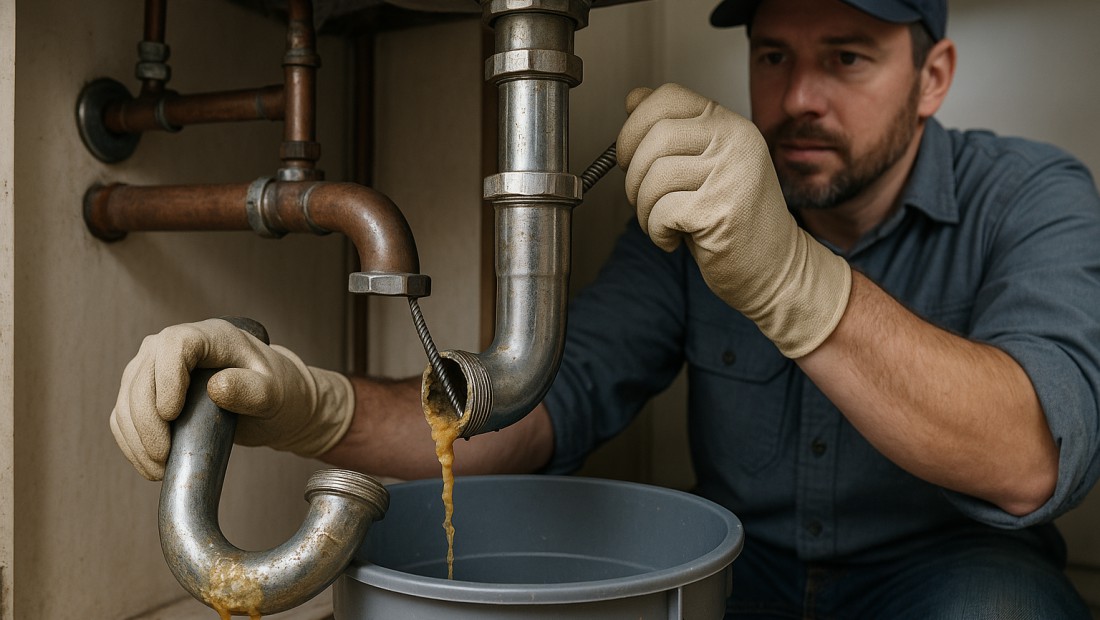
If one drain in your house is going to clog, the odds are it's the kitchen sink. Everything that goes down it — cooking grease, food scraps, coffee grounds, soap, starches from pasta and potatoes — coats the inside of the pipe a little more each day. In Albany's older homes the kitchen line is often the original cast iron or galvanized pipe, narrowed by decades of scale, which makes the buildup add up faster.
The classic pattern: the sink drains a little slower each week, you ignore it, and then one evening it stops entirely — usually mid-meal-prep, with a sink full of dishes. A kitchen clog is rarely a single object; it's an accumulation, which is why a quick plunge often fails to fix it for long.
Why kitchen drains clog
- Grease and fat — they go down as warm liquid and harden on the pipe wall as they cool, building a ring that narrows the channel.
- Starchy food — rice, pasta, and potato peels swell and turn gluey, catching on the grease ring.
- Coffee grounds — they don't break down and settle into a dense sludge in low spots.
- Soap scum — combines with grease to form a hard, waxy buildup.
- Old, scaled pipe — cast iron and galvanized lines in older Albany kitchens have a rough interior that grabs everything.
Do garbage disposals help?
A disposal grinds food finer, but finer particles still coat a greasy pipe — and many homeowners run too little water with them, so the slurry doesn't make it to the main. Disposals also encourage people to send things down the drain that should go in the trash. They're convenient, but they don't prevent clogs; in some cases they accelerate them.
How we clear a kitchen line
- Check the trap. The P-trap and trap arm under the sink catch a lot of clogs and are quick to clear.
- Cable the branch line. If the clog is downstream, we run a cable sized to the pipe to cut through the grease and debris.
- Jet for heavy buildup. When the pipe is coated with years of hardened grease, hydro-jetting scours the walls back to full diameter — a cable just bores a hole through it.
- Test and advise. We run hot water to confirm flow and suggest habits to keep it clear.
Cable or jet?
For a fresh clog, cabling restores flow quickly and affordably. But if your kitchen sink clogs every few months, the pipe is coated and a cable only buys time — it punches through the blockage without removing the grease lining that caused it. Jetting cleans the full pipe wall and resets the clock. For an old, narrow line we'll tell you honestly which makes sense.
Keeping it clear
- Never pour grease, fat, or oil down the drain — can it and trash it.
- Scrape plates into the trash before rinsing.
- Run plenty of cold water with the disposal, and don't overload it.
- Flush the drain weekly with a kettle of hot (not boiling) water to soften light buildup.
- Skip the chemical drain cleaners — they damage old pipe and rarely clear a real grease clog.
A kitchen drain that's slowing down is easy to clear now and a mess to clear later. If yours is draining sluggishly, get it handled before the dinner-party failure. And if it's part of a bigger pattern — multiple drains slow, or the basement drain involved — the kitchen sink may just be the first symptom of a main-line problem.