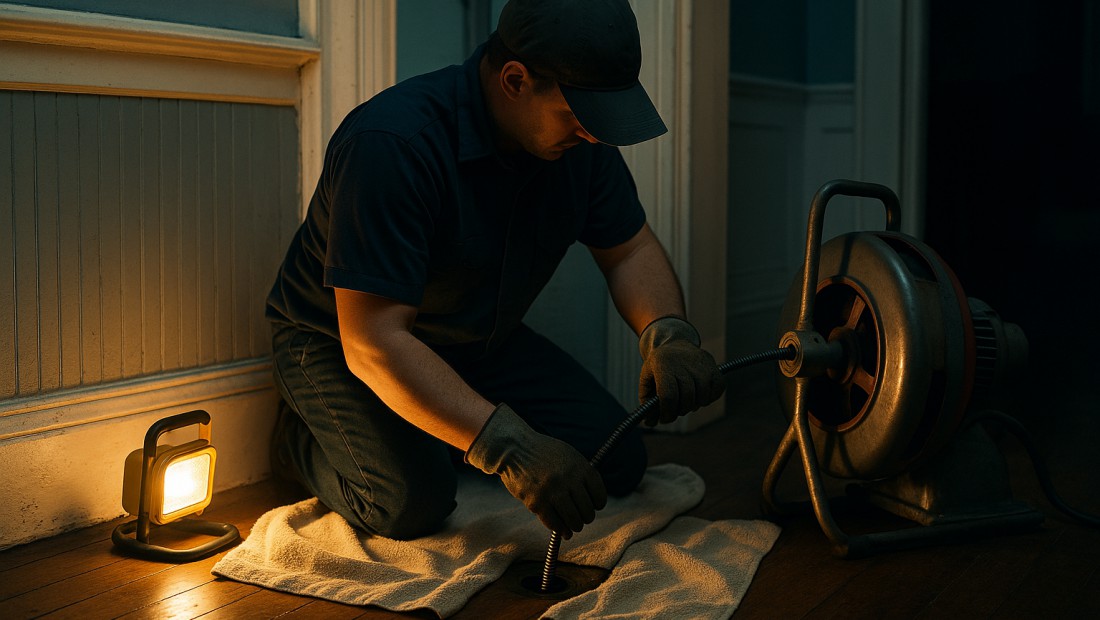
A clogged drain rarely picks a convenient hour. In older Albany neighborhoods — the brick row houses around Center Square, the early-1900s two-families in Pine Hills, the post-war ranches out in Colonie — a single blocked line can put gray water across a kitchen floor or send sewage up through the lowest fixture in the house. When that happens, the clock matters. Standing water damages flooring and drywall within hours, and in a Capital Region winter a backup that freezes overnight turns a quick clearing job into a far bigger repair.
Our emergency drain service covers the whole Albany area around the clock. We carry cabling machines, sectional rodders, and hydro-jetting equipment on every truck, so a technician can diagnose and clear most stoppages in a single visit instead of leaving you to bail buckets until morning.
When a clog becomes an emergency
Not every slow drain needs a midnight call. But certain warning signs mean the blockage has moved past a single fixture and into a shared branch or the main line, where it can affect the entire home. Treat these as urgent:
- Multiple fixtures backing up at once — if flushing a toilet makes the tub gurgle or fills the shower base, the stoppage is downstream of both.
- Water at the basement floor drain — in Albany this is the lowest opening in most homes, so it is the first place a main-line backup surfaces.
- Sewage odor or dark water — a sign the blockage is in the sewer lateral, not the trap arm under a sink.
- Bubbling at floor level after running the washing machine — laundry discharge is high-volume and exposes a partial main-line clog fast.
What we do when we arrive
Speed comes from a methodical routine, not from guessing. A typical emergency call in Albany runs like this:
- Isolate the problem. We identify which fixtures are affected to locate the blockage — a single sink points to a local trap; a whole-floor backup points to a branch or the main.
- Open the right access point. Most Albany basements have a main cleanout near where the line exits toward the street; older homes may need us to pull a toilet or use a roof vent.
- Clear the line mechanically. We cable or rod the stoppage, matching blade size to pipe diameter so we cut through grease, roots, or debris without harming old cast iron or clay.
- Verify flow. We run water to confirm the line carries freely and that no secondary clog is hiding downstream.
- Recommend follow-up if needed. If we find roots or a collapsed section, we explain options — a camera inspection, jetting, or a longer-term repair — without pressure.
Why Albany homes back up
The Capital Region has a particular mix of conditions that produce emergency clogs. The housing stock is old — large parts of Albany, Troy, and Cohoes were built before 1940, with original clay or cast-iron laterals that have decades of scale and joint offsets. Mature maples and oaks line many streets, and their roots find every crack in those old joints. Postwar suburbs like Colonie, Guilderland, and Delmar were often plumbed with Orangeburg pipe — a tar-paper product that softens and collapses with age. And the freeze-thaw cycle works on everything underground, shifting pipe and opening seams a little wider each winter.
Sewage backups need extra care
If the water coming up is dark or smells of sewage, the situation is a health issue as well as a plumbing one. Raw wastewater carries bacteria, and porous materials it touches — carpet, drywall, cardboard storage — usually cannot be salvaged. We clear the line first to stop the source, then walk you through safe cleanup and what your insurance is likely to cover. For the full process, see our sewage backup cleanup page.
What it costs — and what to expect
Emergency pricing depends on access, the location of the blockage, and the equipment needed. A straightforward sink or tub clearing is at the low end; a main-line stoppage that requires pulling a toilet or jetting heavy buildup costs more. We give you a number before we start, so there are no surprises after the water is gone. You can ballpark a job with our cost estimator, but the honest answer for an emergency is that we quote on site once we see the access and the cause.
Most important: clearing the immediate clog is step one, not the whole story. A drain that backs up repeatedly is telling you something — roots, grease, a belly in the line, or failing pipe. Once the crisis is over we are happy to scope the line and lay out your options, but we will never upsell you on a repair you do not need to solve tonight's problem.