Every drain in your house — sinks, toilets, tubs, the washing machine, the basement floor drain — eventually feeds one pipe that carries waste out to the municipal sewer or septic system. That pipe is the main line, or building lateral. When it clogs, the whole house is affected at once, and the symptoms are unmistakable: flushing a toilet sends water up into the tub, the lowest drains gurgle, and the basement floor drain overflows when you run the washer.
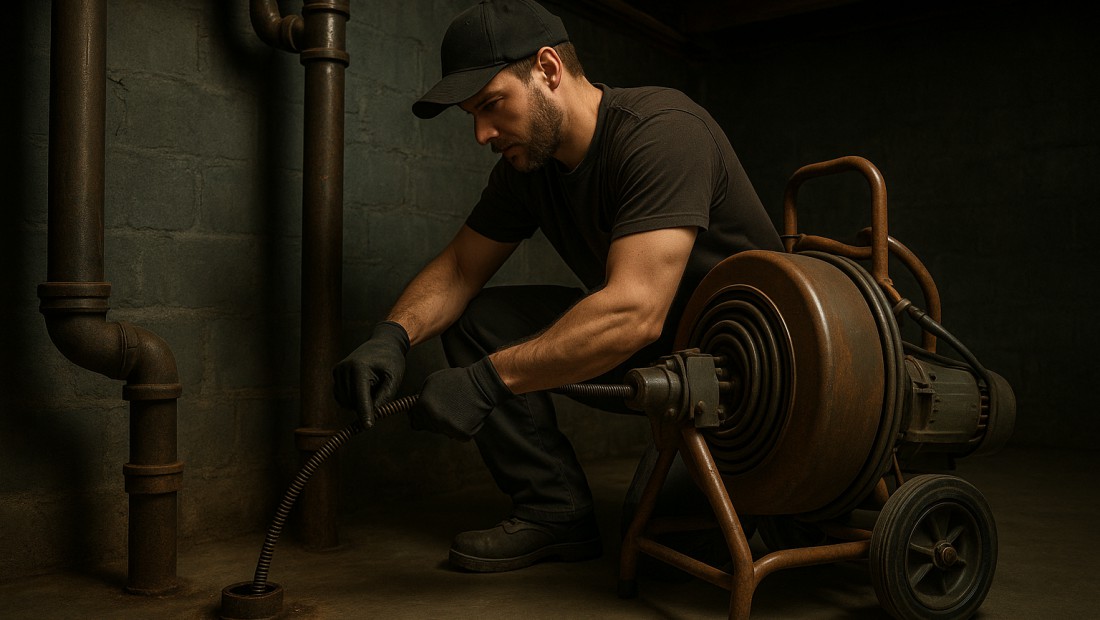
A main-line stoppage is not a job for a hardware-store snake. The pipe is large — typically four inches — and the blockage is often thirty, fifty, or a hundred feet from the house, out under the yard or the street. Clearing it takes a powered cable machine or a hydro-jetter run through a proper cleanout.
How to tell it's the main line
- Two or more fixtures back up together, especially on the lowest floor.
- A toilet flush makes a nearby tub or shower gurgle or rise.
- The basement floor drain overflows when you run the kitchen sink or washer.
- You hear bubbling from drains after heavy water use.
- Sewage odor lingers in the basement.
What causes main-line clogs here
The Capital Region's old infrastructure shapes the usual suspects. Tree roots are the number-one cause in established neighborhoods — the maples and oaks that make Pine Hills and Delmar beautiful send hair-fine roots into every joint, where they swell into a dense mat. Grease congeals on pipe walls over years, narrowing the channel until a wad of wipes or a holiday's worth of cooking fat finishes the job. Collapsed Orangeburg pipe in mid-century suburbs creates a permanent restriction. And pipe bellies — low spots where the line has sagged from soil movement and frost heave — collect debris that eventually dams up.
Our approach
- Confirm the diagnosis. We verify it's the main line and not a shared branch by checking which fixtures are involved.
- Access through the cleanout. We run a powered cable sized to the pipe, or jet the line if buildup is heavy.
- Clear and confirm. We open the blockage and run water to verify full flow to the street.
- Camera if warranted. If we suspect roots or a structural defect, we scope the line so you can see exactly what's down there.
Cabling vs. hydro-jetting
A cable machine punches a hole through the blockage — fast and effective for a discrete clog or to cut roots back. Hydro-jetting uses high-pressure water to scour the full pipe wall clean, removing grease and root remnants that a cable leaves behind. For a one-time emergency, cabling restores flow immediately. For a line that clogs every year, jetting gives a longer-lasting result. We'll recommend the right tool for your situation rather than defaulting to the more expensive one.
When clearing isn't enough
Sometimes the camera reveals that the pipe itself has failed — a collapsed section, an offset joint where the ground has shifted, or Orangeburg that has gone oval. No amount of cabling fixes a broken pipe; it just buys time until the next backup. When that's the case we walk you through repair options, from spot trenchless repair to full line replacement, with honest pricing for each.