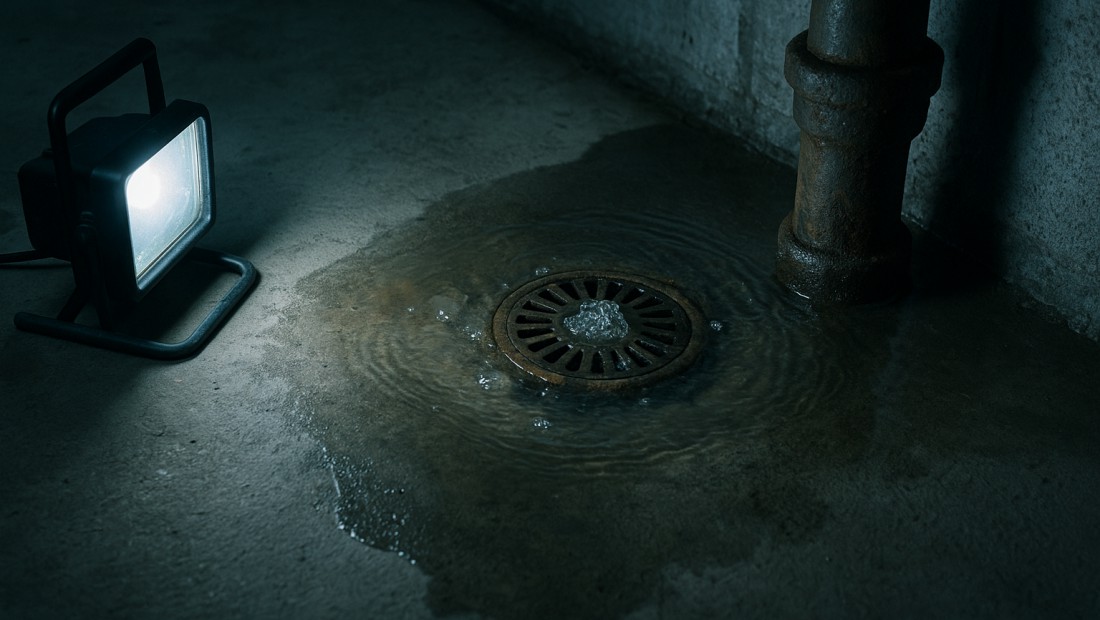
Few sights make a homeowner's stomach drop like water — or worse, sewage — rising up through the basement floor drain. In the Capital Region, where basements are nearly universal and slab-on-grade homes are rare, this is one of the most common serious plumbing calls we get. And it's widely misunderstood: people assume the floor drain itself is clogged, when in fact the floor drain is usually working exactly as designed — as the relief point for a problem further down the line.
Why it surfaces in the basement
The basement floor drain sits at the lowest point of your home's drainage system. When the main sewer lateral is blocked downstream, wastewater from everything above — kitchen, bathrooms, laundry — can't get out to the street, so it backs up and finds the lowest opening to escape. That's the floor drain. So a basement backup is usually not a floor-drain problem at all; it's a main-line problem announcing itself at the basement's lowest point. (For the broader pattern, see multiple drains backing up.)
What causes basement backups in Albany
- Main-line blockage — roots, grease, collapsed Orangeburg, or a pipe belly choking the lateral.
- Combined-sewer surcharge — in older parts of Albany, Troy, and Cohoes, storm and sanitary lines share a main; heavy rain or fast snowmelt can overwhelm it and push water back toward basements.
- A clogged floor-drain line itself — less common, but the short line from the drain to the main can silt up.
- Spring snowmelt and high water tables — seasonal water volume that overtaxes a marginal line.
The seasonal pattern
Basement backups in our region cluster in two seasons. Spring brings snowmelt, saturated ground, and roots growing into joints — a recipe for both main-line clogs and combined-sewer surcharge. And after a hard winter, freeze-thaw shifts buried pipe and opens joints, so problems that were dormant suddenly appear. If your basement drain backs up every spring, that's a structural pattern worth investigating rather than mopping up annually.
- Stop the inflow. We get water-using fixtures and appliances shut down so the backup stops growing.
- Clear the main. We clear the blockage through the cleanout, restoring flow to the street.
- Camera the line. We scope the lateral to find the cause — roots, belly, Orangeburg, or a one-time clog.
- Discuss prevention. Depending on the cause, that may mean jetting, a repair, or a backwater valve to guard against surcharge.
Can a backwater valve help?
For homes that back up repeatedly — especially on combined-sewer streets or low-lying lots near the Hudson — a backwater valve is worth considering. Installed in the lateral, it lets wastewater flow out but closes automatically if the public main surcharges and tries to push water back in. It's not right for every home and needs occasional maintenance, but where the risk is real it can protect a finished basement from repeat flooding.
Don't just mop and hope
A basement backup that you clean up without finding the cause is very likely to return — often worse, and often at the worst time. The water is a symptom; the cause is downstream. We'll clear the immediate backup around the clock, then show you on camera what's actually going on so you can decide how to keep it from happening again. If your basement floor drain has backed up, call us — and stop running water upstairs until we've cleared the line.