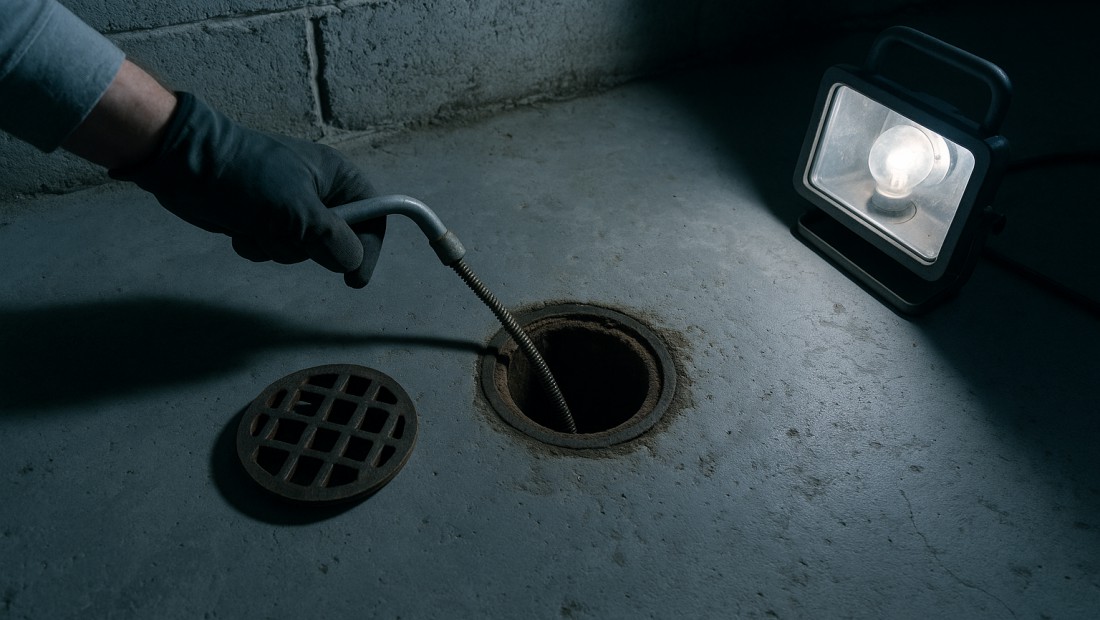
The basement floor drain is easy to ignore right up until the moment it matters. It's there to carry away water from a leaking water heater, a washing-machine overflow, snowmelt tracked down the stairs, or seepage during a wet Capital Region spring. Because nearly every home in the Albany area has a basement — a sharp contrast with regions where slab construction dominates — the floor drain is a fixture almost every local homeowner depends on, often without realizing it.
Floor drains clog quietly. Sediment, lint, laundry detergent residue, and dust settle into them over years. The trap below dries out from disuse and lets sewer gas into the basement. And because the floor drain is the lowest point on the system, it's the first place a main-line backup appears — which is why a "clogged floor drain" is sometimes a symptom of something much bigger.
Two very different problems
When a floor drain won't take water, there are two possibilities, and they call for opposite responses:
- The drain itself is clogged — sediment and debris have filled the trap and the short line to the main. This is a straightforward cleaning.
- The main line is backing up through it — the drain is fine, but the lateral downstream is blocked and water is surfacing at the lowest opening. This is a main-line emergency, not a floor-drain cleaning.
The dried-out trap
Every floor drain has a trap — a U-shaped bend that holds water to block sewer gas from rising into the house. In a basement that stays dry for months, that water evaporates, the seal breaks, and you get a sewer smell with no obvious source. The fix is simple: pour a gallon of water (a splash of mineral oil slows future evaporation) into the drain to refill the trap. If the smell persists after refilling, the trap or line may need attention.
How we service a floor drain
- Clear the strainer and bowl. We remove the cover and clean out the sediment and debris that collect in the drain body.
- Clean the trap. We clear the trap of built-up sludge and verify the water seal.
- Cable the line to the main. If the short line is blocked, a small cable clears it.
- Rule out the main. If the backup is coming from downstream, we shift to diagnosing the main line rather than just cleaning the drain.
Why this matters in Albany
Our wet springs, heavy snowmelt, and high water tables put real demand on basement drainage. A floor drain that's silted shut can't do its job when the water heater finally lets go or a March thaw sends water across the floor. And in homes on combined-sewer streets, the floor drain is the exact spot where a public-main surcharge pushes water back in — which is why we sometimes recommend a backwater valve for at-risk basements.
Keep it ready
- Pour a gallon of water into the floor drain every couple of months to keep the trap sealed and the smell out.
- Keep the area around the drain clear so debris doesn't wash in.
- If you've ever had it back up, ask us about a camera inspection and whether a backwater valve makes sense.
- Don't use the floor drain as a disposal for paint, solvents, or sediment-heavy rinse water.
A basement floor drain is cheap insurance against an expensive flood — but only if it works. If yours is slow, smelly, or backing up, we'll figure out which of the two problems you actually have and fix the right one.